Introduction
Tablet coating is the process of applying an edible film to the surface of a pharmaceutical dosage form to provide specific benefits such as taste masking, protection, or controlled release.
This additional step in tablet manufacturing increases production cost but enhances product stability and appearance.
Coating can be applied to various solid dosage forms, including tablets, pellets, pills, and drug crystals.
During coating, a polymer-based coating solution is sprayed onto tablets in a rotating coating pan. As the tablets dry, a uniform and non-sticky film forms on the surface.
To achieve consistent coating quality, critical parameters such as spray pattern, droplet size, and nozzle distance must be precisely controlled.
PTK Tablet Coater Overview
The PTK PC Series Tablet Coating Maching brings an industry-proven design integrated with high-performance features and technology.
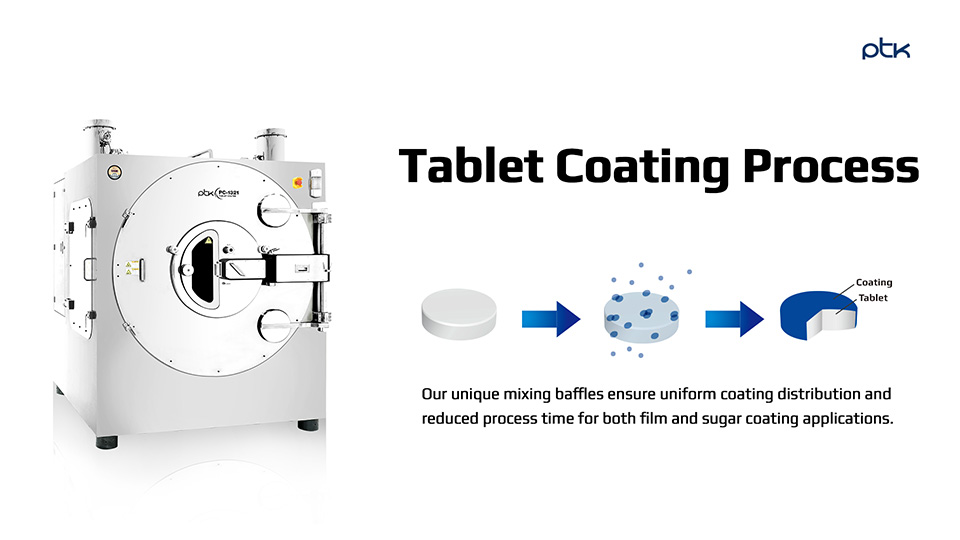
Our unique mixing baffles enable fast and proficient tablet coating using film or sugar coating solutions.
Streamlined and directed airflow through the coating chamber with full duct control reduces air consumption, resulting in increased drying efficiency and therefore reduced coating times and costs.
Our WIP cleaning system ensures fast, systematic, and effective cleaning, greatly reducing the time before the next batch of tablet coating.
Coating Process for Tablets

In tablet coating, achieving a uniform coating that resists cracking under stress is essential. To ensure this, various techniques have been developed for applying coating solutions to tablet surfaces. Typically, the coating solution is sprayed onto uncoated tablets while they are agitated in a rotating coating pan. As the solution is applied, a thin, uniform film forms on each tablet, and heated air evaporates the solvent, leaving a dry, non-sticky coating. The coating can be formed in a single application or built up through multiple spray cycles, depending on the product and process requirements.
This process ensures even coverage, maintains tablet integrity, and supports controlled drug release. Rotating coating pans are widely used in the pharmaceutical industry for their ability to provide consistent agitation and efficient coating.

Sugar Coating & Film Coating
Sugar Coating Process for Tablets
Sugar coating of tablets was developed to mask unpleasant tastes and improve tablet appearance. The process involves several steps:

1. Sealing – A protective coat prevents moisture penetration
2. Sub Coating – Rounds tablet edges and increases weight.
3. Syrup Coating – The imperfections in tablet surface are covered up and the predetermined size is achieved. (most skill-intensive step).
4. Coloring – Adds the final tablet color.
5. Polishing – Applies wax (beeswax or carnauba) for gloss and shine.
Film Coating Process for Tablets
Because sugar coating is time-consuming and skill-dependent, it has been largely replaced by film coating of tablets. In this process, a solution containing polymer, pigments, and plasticizer is sprayed onto a rotating tablet bed to form a thin, uniform film.
The choice of polymer in tablet film coating depends on the desired site and rate of drug release.

An ideal tablet film coating material should be:
• Soluble in suitable solvents
• Stable to heat, light, and moisture
• Non-toxic, inert, and aesthetically acceptable
• Compatible with coating additives
View products
'Tablet Coater' 카테고리의 다른 글
| Tablet Coater for Stable Pharmaceutical Tablet Coating (0) | 2026.04.13 |
|---|---|
| Flexible Tablet Coating Solution for Mid-Scale Pharmaceutical Production (0) | 2025.12.22 |
| Tablet Coater Pilot │PC-C620 (0) | 2025.08.08 |


